Life School

The past several months I have debated getting another degree.  Although I already received my doctorate nearly 20 years ago in clinical psychology, I have always been engaged in ongoing education in some capacity.  I was exploring getting an additional degree in Mythology, and preparing my life to be inclusive of this.  This was until I realized the costs of tuition.  I had believed the annual cost would be $10,000.  This was reasonable and achievable, but I realized I was wrong.  That is the cost per quarter, not year.  I had wrongfully calculated this, and it would be $34,000 per year for four years.  At this juncture in life, I realize that I value my financial freedom more than this program.  

I began exploring, what if I could create my own type of mythology program.  In this, I would still take classes in the realm of Carl Jung and Depth Psychology, but also begin reading other books that had to do with goddesses, the Dark Sacred Feminine, and world religions.   In my journal last night, I brainstormed a list of individuals I would want to learn from, some of whom I had already met int the past.  This list is below.
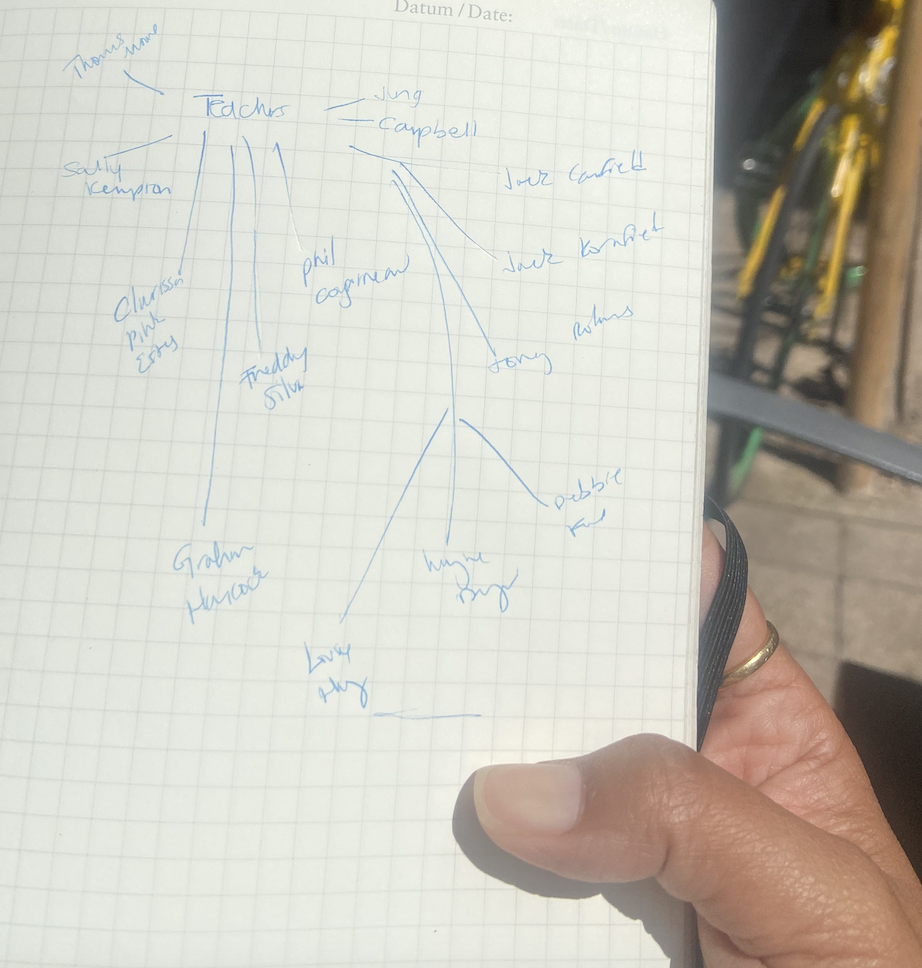
As I began, going to some of their individual websites, I stumbled upon some live events I could attend, or at the bare minimum live webinars.  Yet, I came upon googling Sally Kempton, renowned teacher of Hindu philosophy particularly goddesses.  I discovered something horrible.  She died two months ago! She was 80 years old.  And this is a regret I have, I never studied with her when I got the chance.  I was lucky to meet and see Louise Hay, Debbie Ford, and Wayne Dyer before they died.  But Sally Kempton, I put off, then the pandemic put on hold all live events for an extend period.  And it never happened.  After I saw that this morning, I am vowing to not let that happen again.  

And therefore, I may not be attending graduate school again, but I am vowing to enter the School of Life.  I am making a commitment to study and meet experts in the fields that I am fascinated in, before it’s too late.   This could be in the realm of psychology, spirituality, anthropology, mythology, goddess philosophy, or anything that I fancy at the moment. I will follow my curiosity and see where it leads me in this school of life.  It may not lead to a terminal degree, but it will lead to a fuller life. 
Back to Spanish Class

“Change your language and you change your thoughts.”
Karl Albrecht

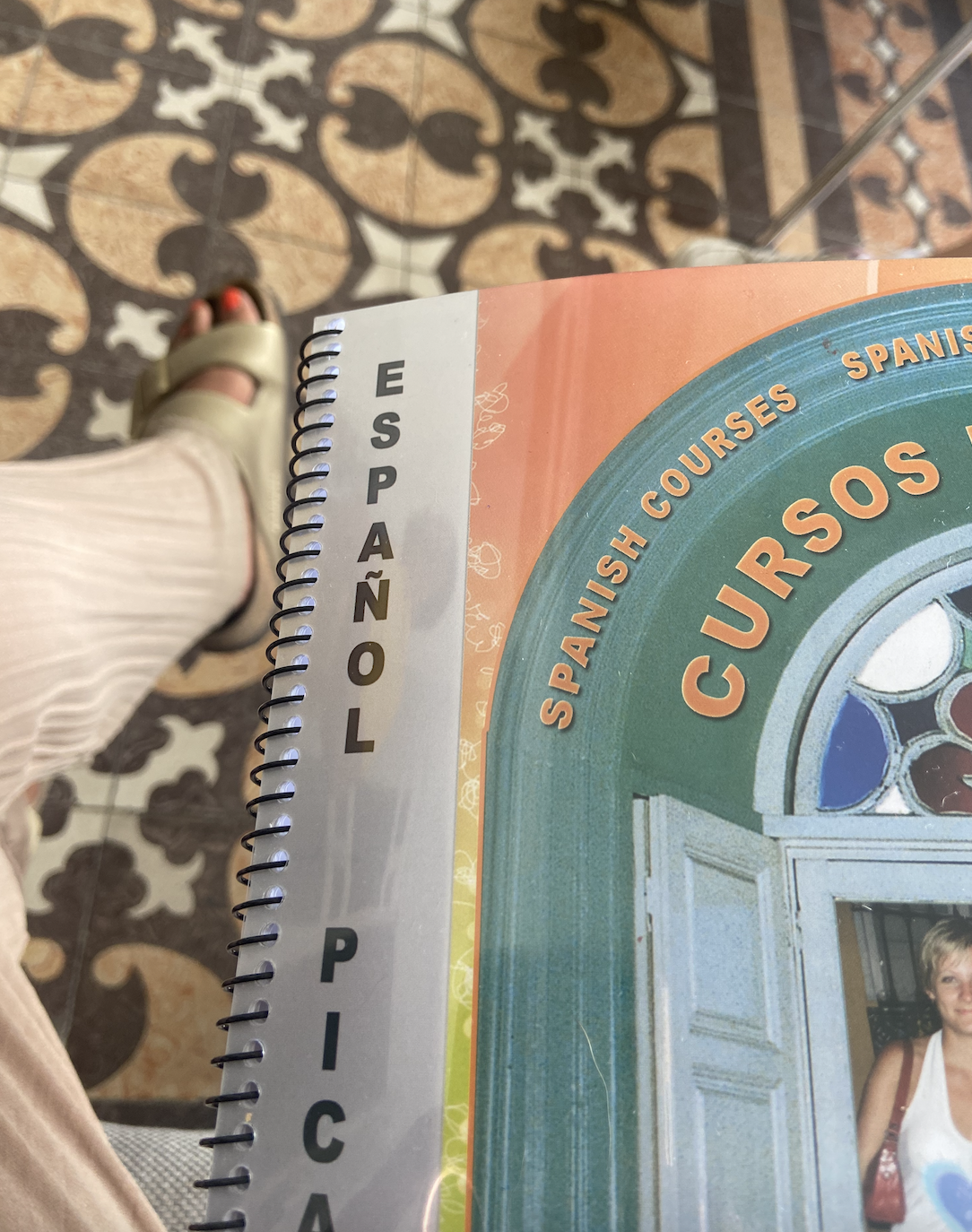
            Last week I enrolled in a month long intensive Spanish course.  Although I have officially moved here nearly six months ago, I have put this off.  While in Paris last year, I took three months of French, and it made me cringe.  I hated starting from scratch, pronouncing everything all wrong, and be corrected constantly.  I didn’t think I would need Spanish here, but I have recognized and accepted that my Spanish was more of a tourist Spanish.   Additionally, Andalucians seem to sometimes speak a different language, with shortening the words or have nicknames for things that did not make sense.  Who knew that mala leche (which is translated to bad milk) equates with having a day where you are pissed off and angry?  If I wanted to improve, it required an intensive.  To commit to this was to commit to a part time job, twenty hours a week, Monday through Friday for four weeks.  But now I could do it.

            And I was pleasantly surprised. 

            It was actually somewhat enjoyable.  I had taken Spanish class in high school, college, and did an immersion in graduate school.  As we went around the room, verbalizing our background with Espanol, I realized it has been over twenty years since I had taken Spanish (Duolingo doesn’t count).  I could have compassion for myself with forgetting some things along the way. 

In the classroom, sat next to me a 14 year old Bosnian girl, living in Sweden. She showed me texts from her boyfriend and teacher, gossiping about her life as if we knew each other for years.  She guessed me to be in my 20s, when I shared I was in 40s, she was stunned. And I was flattered.  The class size generally stayed around 8 people, from other countries such as Morocco, Netherlands, England, and Italy.  Although we were collectively learning Spanish, we were learning about each other.  Our conversational skills were put to the test as we shared our background information, occupation, likes, dislikes, hobbies, and family dynamics.  “Me llamo Tricia.  Me gusta caminar con mi amigo.  Soy americana, pero ahora vivo en Malaga por seis meses…”  This was repeated throughout the week, because with four hour long sessions, the teachers rotated in and out.  We could practice hearing different accents, dialects, and experience various teaching styles. 

            But all were pleasant.  Yes we were corrected at times, but it was with encouragement.  For some reason, my experience with learning the French language is it was tiresome and draining, it probably didn’t help that we wore masks for most of the sessions.  I recall practicing my Spanish with a local here several months ago, who was training to be a language teacher.  He laughed when I pronounced various words, and therefore it shut me down.  Why open oneself to ridicule in the hopes of improving?  A warm encouraging environment is so necessary to offer padding to those learning something new.  If you fall, it’s not so bad.  You are then willing to try again, criticism didn’t knock you down.  At least for me, this is my preferred learning style.  

            And so I am ready to enter week 2 of classes, with more energy, less cringe, and curiosity of what will be revealed next.   As I write this, I am full of appreciation for the teachers out there who have the kind patience in working with their students, and for all students out their who have self-compassion as they learn something new.

My Current Life Courses

Anyone who stops learning is old, whether at twenty or eighty. Anyone who keeps learning stays young.”

―  Henry Ford

This week, I found myself enrolled in 3 courses, facilitating 1, and have paused 1.  No, I’m not a graduate student.  I am a 44 year old female who is transitioning out of my field of being a clinical psychologist and stepping into the unknown world of creating my own path. Although I received my doctorate nearly 20 years ago, I am continuously learning.  I realize in the past my learning was about the attainment of a degree.  I took various classes that would afford me a spot in college, then graduate school, then the right internship.   After getting my license in clinical psychology and having full time employment, it was all about getting certificates in everything from hypnosis, reiki, sound healing, EMDR, executive coaching, labyrinth facilitation, Internal Family Systems, Gottman trained marital therapy, Diversity and Inclusion, 500 hour yoga certificates.  The list goes on, and although I admit initially I did it because my jobs had so much funding in ongoing education and continuing credits, I maxed it out annually.  Today I have no job, and find myself seeking more knowledge. 

But now I have the freedom to choose, without a job paying for it, what am I enrolled in? 

A course about the Black Madonna by Dr. Christena Cleveland.  It’s described as a virtual pilgrimage to explore how the Dark Divine Mother can heal and help us, and how we can view ourselves as sacred.  It’s taught by a female social psychologist and theologian. 

Another course I am getting psychology credit for is Self-Compassion, a class created by Dr. Kristen Neff, a clinical psychologist.  This includes Buddhist and mindfulness principles as a way to make friends and care for ourselves.

In the midst of this, I signed up for a pilgrimage course e-course by Phil Cousineau who is a filmmaker, mythologist, and retreat facilitator.  He previously was mentored by my favorite mythologist Joseph Campbell and therefore this class is focused on how to be intentional with each trip we take and facilitate these types of reflective spiritual inquires when leading others.  

The course I am facilitating, which I seem to do annually, is The Artist Way by Julia Cameron.  This is all about reclaiming our creativity, and although I facilitate it, I also participate in it and the majority of the exercises.   My only class on pause, due to scheduling, is Flamenco , taught by a local Malguena in complete Spanish. 

Black Madonna, Pilgrimage, Compassion, Art, and a tad of Flamenco.  

If I were to capture who I am right now in five classes this would be it.  But the thing is, I am not doing these classes right now to check  them off a list.  I want to embed the lessons in my body.  It’s the integration that takes time.  

What classes in life are you currently enrolled in?  How would you sum up who you are in five classes? 

Oh La La

While taking a stroll in a local Parisian park, a recent expat said to me, “The French really like saying Oh La La.”  Prior to living in Paris, when I heard the phrase “Oh La La”, I thought it simply would be the phrase that would come out of Miss Piggy’s mouth from The Muppets when she saw Kermit.  For me, it meant “Wow”, “Sexy”, or “I love this.”  But it’s multidimensional.  I heard the phrase three times this week, used in different contexts.

1-Frustration:

I was in the line of a marche (market).  I had several items, the woman behind me had one item, and the old man in front of me pulled out his entire rollie of products to be scanned.  The woman behind me sighed “Oh La La,” as he emptied the entire contents of 20 plus products to the cash register.  She did not want to wait and was frustrated there was only one cashier that day.  

2-Disappointment:

Earlier in French class this week, we each had to read our answers to various homework questions.  When one person was asked to read the number 85, she could not recall how to say this.  The teacher breathed out, “Oh La La”, disappointed that we were already at the end of 8 weeks of French and a simple number could not be read.  For those, counting it’s pronounced “quatre-vingt-cinq.”  

3-Adoration:

My nearly 15 year old English Bulldog loves going to the park, but does not seem to have the energy or motivation to walk two long blocks to our destination.  Therefore, I transport him in a stroller.  Upon our return from Champs de Mars, a man looked at the tired but content Puzo, and smiled saying “Oh La La”.  I could sense in the hint of “how precious.”

I am sure there are many other ways to use this phrase.  It’s a catch all like, “Oh my gosh”, “Ay ya ya”, “Geez Louise.”  This is one phrase that seems stereotypical, but I am going to try to embed into my vocabulary.  Perhaps you will catch me next time saying “Oh la la,” but hopefully in a complimentary way. 

Positif ou Négatif

The other day in French class we were learning various adjectives for emotions or character traits: triste, agreable, serieux, desagreable.  We had to quantify if these words were positive or negative.  We got to a word “orgueilleux,” which according to google means “proud.”  A classmate noted, “c’est positif.”  The teacher disagreed, and the student looked at the class, shrugged his shoulders and said “depends.”  The teacher then shared that it means more than proud, it means “arrogant.”  This is pride discussed in the way Jane Austen would back in the day.  So the class agreed, “c’est negatif.”  

It’s interesting as a psychologist, to sit in a classroom and label emotions as “bad or good.”  This is what we are trying to get away from in society, as all emotions should be welcome.  There’s a time and place for sadness, anger, joy, and seriousness.  But I understand, we are doing this exercise, solely as a learning experiment.  The images shown to describe the emotions were the universal language of emojis. 


When you are in a beginners language class, generally there is no room for debate or philosophical discussion.  It’s basically a time for memorization, particularly if the words are positif or negatif, or feminin ou masculin.